China Best Diamond Hole Saw Supplier?
Choosing the China Best Diamond Hole Saw Supplier requires more than comparing catalog prices. A reliable supplier should understand porcelain tile, reinforced concrete, granite, glass, and other demanding materials. Each surface needs a suitable diamond bond, cutting depth, segment design, and cooling method. The wrong combination can create chipped edges, overheated cores, or short tool life.
Dr. Andrew Keller, a diamond-tool engineering specialist, explains, “The best Diamond Hole Saw is matched to the material, not chosen by price.” This principle deserves attention. A professional supplier should provide clear specifications, sample testing, production photos, and consistent quality records. Look for details such as diamond grit, wall thickness, connection type, recommended rotation speed, and wet or dry cutting instructions. Factory audits and third-party testing can add confidence, but paperwork alone proves little.
Real performance matters.
A strong Chinese manufacturer should show practical experience with different drilling conditions. Ask whether its engineers can adjust the bond for hard granite or fragile ceramic tile. Confirm packaging quality, replacement support, delivery reliability, and communication speed. Some suppliers advertise excellent lifespan without publishing test conditions. That claim may be incomplete. Even a premium Diamond Hole Saw can fail when the operator uses excessive pressure or insufficient cooling. This guide will compare supplier capabilities, product engineering, quality control, customization, and after-sales service. The goal is not to name the cheapest option. It is to identify a dependable partner whose tools perform consistently on the jobsite, where uneven materials and rushed decisions often expose weaknesses.
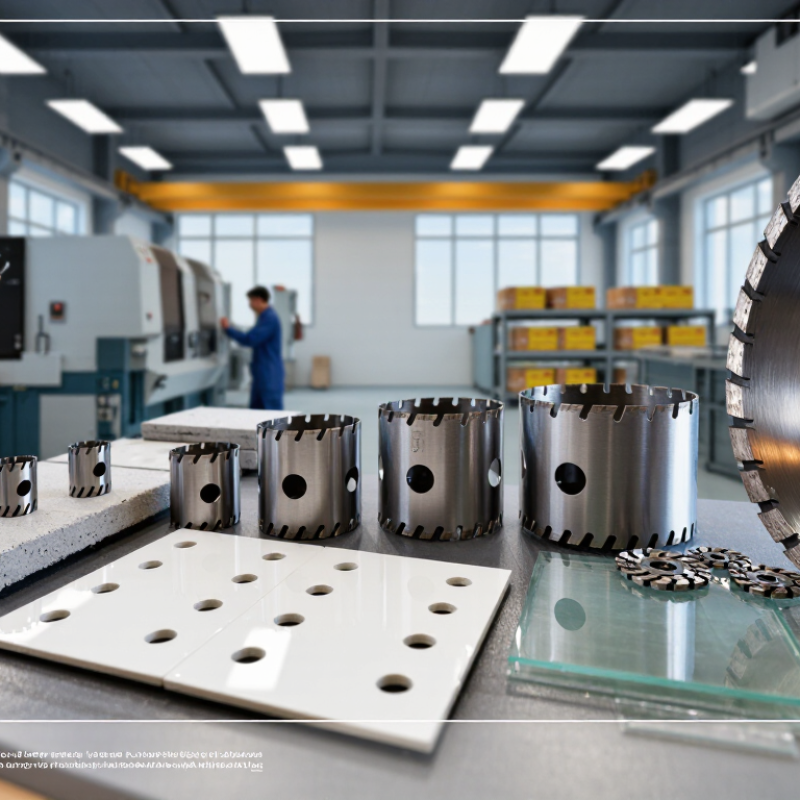
What Makes a Diamond Hole Saw Supplier the Best in China?
A capable diamond hole saw supplier in China should prove performance, not merely promise it. Experienced suppliers understand that porcelain tile, glass, granite, and reinforced concrete require different diamond grits and bond designs. They should explain selection clearly. Their engineers can recommend diameter, cutting depth, arbor type, and drilling speed for each material. Ask for sample cuts. The dust, edge chipping, and service life become visible quickly.
Technical confidence needs evidence. A reliable manufacturer records diamond concentration, segment dimensions, braze quality, and runout during production. Batch testing should measure cutting time and usable life under defined conditions. Request inspection reports, material specifications, and clear tolerance data. Good suppliers also provide practical guidance on water cooling, pressure, and safe operating limits. Their advice should match real jobsite conditions, not only laboratory figures. Some suppliers may present impressive numbers without explaining test methods. That gap deserves scrutiny.
Reliability appears in communication and repeatability. Response times, packaging details, replacement policies, and export documentation reveal operational discipline. A stable supplier keeps dimensions consistent across different orders. Production capacity matters when a project suddenly expands. However, large capacity alone proves little. I would inspect factory processes, review recent customer feedback, and test a small order before committing. Even experienced buyers can choose the wrong bond for unfamiliar stone. That mistake is useful if the supplier responds honestly and adjusts the specification. Transparent correction builds more trust than polished sales language.
China Best Diamond Hole Saw Supplier? - What Makes a Diamond Hole Saw Supplier the Best in China?
| Evaluation Dimension | Recommended Benchmark | Why It Matters | How to Verify a Supplier |
|---|---|---|---|
| Product Range | Common diameters from approximately 5 mm to 150 mm, with metric and imperial options | A broad size range supports tile, glass, masonry, and installation projects without requiring multiple sources. | Request a current size chart, dimensional tolerances, and samples from several diameter groups. |
| Diamond Working Layer | Uniformly distributed diamond particles with a consistent electroplated or bonded working layer | Even diamond distribution helps maintain cutting speed, hole quality, and tool life. | Inspect the cutting edge under magnification and compare performance across repeated samples. |
| Suitable Materials | Clear application guidance for ceramic tile, porcelain, glass, marble, granite, and other brittle materials | Different materials require different cutting speeds, cooling methods, and diamond specifications. | Ask for a material-to-tool selection guide and test the tool on the actual workpiece. |
| Shank Compatibility | Options such as hex, round, SDS-compatible, and threaded connections, depending on the product type | Correct shank design improves tool fit, operating stability, and user safety. | Confirm shank dimensions, thread specifications, and compatibility with the intended drill or grinder. |
| Cooling Requirements | Clear instructions for wet cutting, dry cutting, or intermittent cooling; water is commonly used for tile and glass | Cooling reduces heat buildup, helps control dust, and can extend the working life of the diamond layer. | Review operating instructions and conduct a controlled test using the recommended cooling method. |
| Cutting Accuracy | Stable diameter, low edge chipping, and a clean entry and exit during practical testing | Accuracy affects fitting quality, installation time, and the risk of damaging expensive surfaces. | Measure finished holes with calibrated equipment and record chipping, roundness, and total drilling time. |
| Tool Life | Published life data based on a specified material, hole diameter, machine, speed, and cooling method | Tool-life claims are meaningful only when the test conditions are clearly defined. | Request test conditions, inspect used tools, and compare the number of acceptable holes produced. |
| Manufacturing Consistency | Stable dimensions, repeatable diamond-layer placement, and documented process controls | Consistency is essential for repeat orders and reduces variation between production batches. | Review quality-control procedures, batch records, inspection reports, and pre-shipment samples. |
| Quality Management | Traceable inspection procedures aligned with a recognized quality-management system, such as ISO 9001 | Documented quality processes make defects easier to identify, correct, and prevent. | Verify certificate validity, scope, issuing body, and whether the certificate covers the relevant manufacturing site. |
| Safety Information | Clear maximum-speed guidance, PPE recommendations, cooling instructions, and warnings against unsuitable use | Diamond hole saws can generate heat, dust, fragments, and rotating hazards if used incorrectly. | Check packaging, labels, manuals, and product documentation before purchase. |
| Customization Capability | Ability to discuss diameter, length, shank, diamond specification, packaging, and application-specific requirements | Customization can improve compatibility with specialized equipment and installation conditions. | Request a written specification sheet, prototype approval process, and change-control procedure. |
| Lead Time and Capacity | Clearly stated sample, production, and replenishment lead times with capacity matched to order volume | Reliable delivery reduces project delays and inventory pressure. | Obtain a production schedule, capacity statement, and delivery history for comparable orders. |
| Packaging and Export Readiness | Protective packaging, accurate product labels, carton specifications, and export documentation | Good packaging helps prevent edge damage, corrosion, and identification errors during transport. | Review packaging samples, barcode or label requirements, packing lists, and shipping documents. |
| Technical Support | Responsive guidance on material selection, cutting parameters, troubleshooting, and after-sales claims | Technical support helps users achieve the expected performance rather than judging the tool only by price. | Send practical application questions and evaluate the clarity and speed of the technical response. |
| Total Cost of Ownership | Compare purchase price, usable hole output, labor time, breakage rate, shipping, and replacement cost | The lowest unit price may not be the lowest cost per finished hole. | Calculate cost per acceptable hole using identical test conditions and documented results. |