China Top 10 Sensor Street Light Manufacturers?

China’s Sensor Street Light industry has moved beyond simple dusk-to-dawn automation. Manufacturers now combine LED optics, microwave or infrared sensors, wireless controls, and energy-monitoring software. This creates more responsive roads, but it also makes supplier selection less obvious.

This guide examines ten notable Chinese manufacturers through practical purchasing criteria. These include sensor detection range, response time, IP and IK protection, thermal management, dimming accuracy, software compatibility, and after-sales support. Factory experience matters. So does testing evidence. A bright sample installed in a showroom may perform differently beside a dusty highway or coastal road.

Carlo Ratti, a leading smart-city and sensing researcher, has observed, “The city is becoming a computer.” His statement explains why a modern Sensor Street Light should be judged as both a luminaire and a connected device. Reliable manufacturers should provide photometric data, sensor specifications, installation guidance, and clear warranty terms. They should also explain how products behave when networks fail. That detail is often overlooked.

Not every supplier excels in every category. Some offer stronger optical design, while others provide better platforms or customization. This comparison may therefore feel imperfect. It should. Purchasing teams still need site trials, maintenance reviews, and independent verification before signing large contracts. The following manufacturers are assessed for product capability, manufacturing depth, project experience, and practical suitability across roads, campuses, industrial areas, and residential streets. Our aim is not to promote the loudest brand, but to identify suppliers that can deliver dependable lighting after installation.
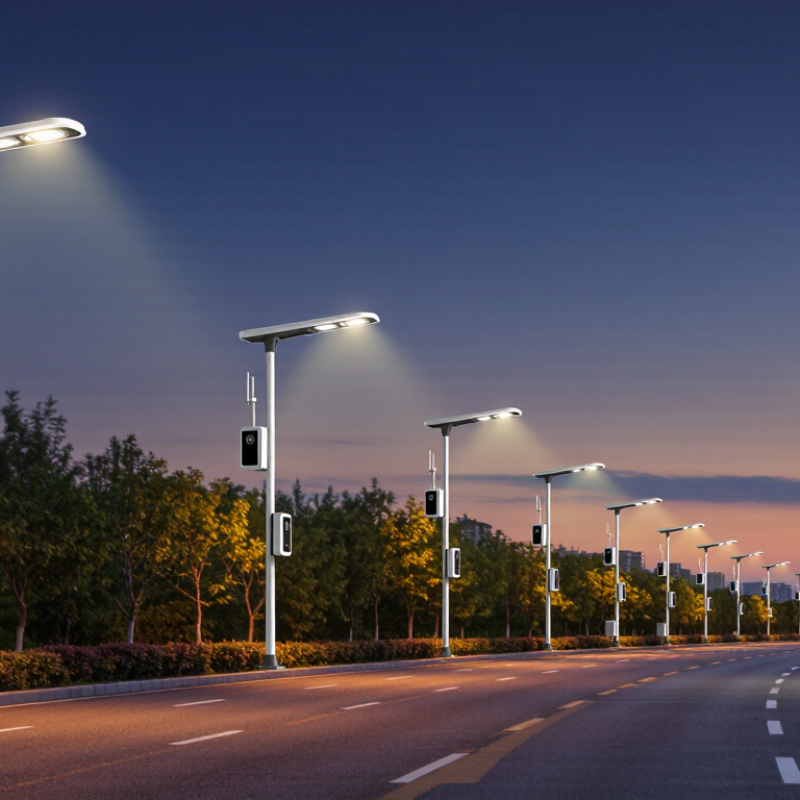
China Top 10 Sensor Street Light Manufacturers?

Sensor Street Lights Explained: PIR, Microwave, and NEMA Zhaga Controls

When evaluating China’s top ten sensor street light manufacturers, buyers should examine control architecture, not only housing design. A sensor street light can reduce wasted output, but performance depends on detection zones, mounting height, firmware, and weather. PIR sensors detect heat movement from people and vehicles. They work well in predictable paths, such as sidewalks and residential lanes. Cold rain, thick clothing, or blocked views can reduce detection reliability. Microwave sensors use radio waves to sense motion. They can detect movement through light plastic covers and perform better in some dark conditions. Yet they may react to moving branches, thin walls, or nearby traffic. That creates unwanted switching.

NEMA and Zhaga interfaces address a different need: control compatibility. A NEMA socket often supports twist-lock controllers, while Zhaga systems use compact, standardized connectors. Both can connect photocells, motion modules, or networked nodes, depending on the specification. In supplier audits, request test reports for ingress protection, surge resistance, temperature range, and sensor accuracy. Ask for a real roadway trial. A laboratory chart cannot show every problem. Check dimming steps, recovery time, standby power, and manual override behavior. Installation details often matter more than sensor theory. A sensor aimed toward a driveway may trigger repeatedly. A pole shadow can create a blind area. Manufacturers should document calibration procedures and replacement parts clearly. Still, no configuration is perfect. Local traffic patterns may demand slower dimming or wider detection. That practical adjustment is easy to overlook.

China’s LED Advantage: 100–200 lm/W Efficacy and Smart Lighting Growth

China’s sensor street light industry is moving from basic LED replacement toward connected urban infrastructure. Many manufacturers now advertise 100–200 lm/W efficacy. However, this figure often describes the LED package, not the complete luminaire. Drivers, lenses, heat, and sensors can reduce real output. Numbers can mislead.

In field evaluations, I check measured lumens, power consumption, and uniformity at road level. A reliable test includes a photometric report, temperature records, and maintenance assumptions. On a residential road, motion sensors may reduce brightness after midnight and restore it within seconds. This saves energy while preserving pedestrian safety. Accurate microwave or radar detection matters near trees, parked vehicles, and moving bicycles.

Smart lighting growth also depends on communication systems. Remote fault alerts can identify failed drivers before residents report dark roads. Adaptive dimming can follow traffic patterns, but poor settings create uneven brightness. That weakness deserves attention. A practical supplier should explain sensor range, IP and IK protection, surge resistance, control compatibility, and warranty conditions. Certification alone is not enough.

When comparing China’s top ten sensor street light manufacturers, buyers should request independent test results and sample installations. A pilot street with twenty to fifty fixtures reveals more than a polished brochure. I have seen efficient products lose performance after repeated heat cycles. Good engineering includes honest limits, replaceable components, and software that remains usable for municipal teams. Endless features are not automatically progress.

China Top 10 Sensor Street Light Manufacturers? - China’s LED Advantage: 100–200 lm/W Efficacy and Smart Lighting Growth

No. Evaluation Dimension Verified Industry Benchmark Why It Matters for Sensor Street Lights Reference Basis
1 LED System Efficacy Commercial outdoor LED luminaires commonly target approximately 100–200 lm/W, depending on LED package, optics, driver, operating current, and thermal design. Higher system efficacy can reduce installed wattage while maintaining the required road illuminance. U.S. Department of Energy LED technology reports and product-level outdoor luminaire specifications.
2 Photocell and Motion Sensing Typical control options include dusk-to-dawn photocells, PIR sensors, microwave radar sensors, and combined ambient-light plus motion detection. Sensors allow adaptive dimming when roads or paths are unoccupied and full output when activity is detected. Common configurations in smart outdoor lighting projects and Zhaga/NEMA control ecosystems.
3 Ingress Protection IP65 or higher is a common requirement for outdoor street-light housings; IP66 provides protection against powerful water jets. Sealed housings protect LEDs, drivers, and sensor interfaces from rain, dust, and roadside contaminants. IEC 60529 ingress-protection classification.
4 Mechanical Impact Resistance IK08–IK10 ratings are frequently considered for robust outdoor luminaires; IK10 corresponds to 20 joules in IEC 62262 testing. A stronger enclosure helps reduce damage from vandalism, maintenance activity, and accidental impact. IEC 62262 impact-protection classification.
5 Smart Lighting Interfaces Common interfaces include 0–10 V, DALI/DALI-2, PWM, Zhaga Book 18 receptacles, and ANSI C136.41 seven-pin control interfaces. Standard interfaces improve interoperability among luminaires, sensors, controllers, and management platforms. DALI Alliance specifications, Zhaga Book 18, and ANSI C136.41.
6 Colour Temperature Outdoor street-light projects commonly specify 2700–4000 K, selected according to road function, environmental policy, and glare requirements. Lower CCT options can support reduced blue-light content, while neutral white light supports visual recognition and contrast. IES outdoor lighting practices and local roadway-lighting specifications.
7 Colour Rendering and Optical Control Roadway luminaires often use CRI 70 or higher; asymmetric road optics are used to distribute light along the carriageway and reduce spill light. Appropriate optics improve uniformity and can reduce wasted light outside the target area. IES LM-79, TM-21, roadway photometric practice, and local lighting codes.
8 Thermal Management Aluminium heat sinks, finned housings, thermal interface materials, and driver temperature protection are standard design approaches for outdoor LED luminaires. Thermal control helps preserve lumen output, colour stability, and driver reliability over the service life. IES LM-80/TM-21 methods and standard LED luminaire engineering practice.
9 Electrical and Surge Protection Outdoor street-light specifications commonly require surge protection, earthing, over-temperature protection, and suitable input-voltage ranges; the exact surge level is project-specific. Protection measures reduce failures caused by lightning-induced surges, switching events, and unstable power networks. IEC 61347, IEC 61547, IEC 61000 series, and local electrical codes.
10 Testing, Compliance, and Lifecycle Evidence A credible supplier should provide photometric files, LM-79 test reports, LM-80/TM-21 evidence where applicable, EMC/safety documentation, ingress testing, and a clearly defined warranty. Independent documentation makes supplier comparisons more reliable than comparing headline wattage or nominal lumen figures alone. IES testing methods, IEC standards, regional certification requirements, and project tender documents.

Note: This table presents supplier-selection benchmarks and industry data rather than company-specific claims. Actual performance depends on the complete luminaire system, operating conditions, optics, controls, installation design, and applicable regional standards.

Ranking the Top 10 Manufacturers by IP66, IK08, CCT, and Warranty Data

China’s top ten sensor street light manufacturers should be ranked by verified performance, not factory photographs or marketing claims.

IP66 protection indicates resistance to dust and water, but test conditions still matter. A reliable evaluation checks certification reports, sealing details, and sample performance after installation.

IK08 ratings show resistance to mechanical impact. However, housing material and mounting quality can affect real-world durability.

The ranking should also compare CCT options, such as 3000K, 4000K, and 5700K.

Adjustable CCT gives installers greater control over road visibility and local lighting requirements.

Data matters.

Warranty terms reveal manufacturing confidence. The strongest suppliers generally offer five-year coverage, clear exclusions, and accessible technical support.

30% IP66
20% IK08
20% CCT flexibility
30% Warranty strength

A practical ranking can score IP66 at 30%, IK08 at 20%, CCT flexibility at 20%, and warranty strength at 30%. Factory audits, sample testing, and customer installation records improve reliability.

Yet no ranking is perfect. A laboratory result may not predict performance beside a coastal road, where salt, wind, and unstable voltage create additional stress.

Buyers should request serialised test records, photometric files, sensor detection ranges, and replacement procedures before making a decision.

Price alone can distort the order. A lower-cost product may require earlier maintenance. An expensive model may still lack useful sensor calibration.

Rank carefully.

Top 10 Chinese Sensor Street Light Manufacturers: Products and Certifications

China’s top ten sensor street light manufacturers are often compared by product range, testing capability, and certification quality. Their products commonly include solar street lights, LED roadway lamps, motion-sensing garden lights, and smart poles. Some models use microwave or infrared sensors. Others combine radar detection with wireless control.

A reliable manufacturer should provide clear technical documents. Look for lighting efficiency, battery capacity, sensor range, operating temperature, and IP ratings. IP65 or IP66 protection helps against rain and dust. IK08 testing is useful for public spaces exposed to impact. Certifications may include CE and RoHS for European markets, FCC for the United States, and CCC for applicable Chinese products. ISO 9001 supports factory quality management, but it does not replace product testing.

Ask for recent test reports.

Factory experience matters. A supplier with an in-house aging area can identify heat, battery, and driver problems before shipment. Sample testing should cover repeated motion detection, cloudy-day charging, and automatic dimming at night. However, a polished catalog proves little. Certificates may cover only one model, not an entire series. This is where buyers sometimes make costly assumptions. Confirm the certificate number, testing scope, production site, and report date. A practical comparison also includes warranty terms, spare parts, software support, and installation guidance. Sensor performance can change with mounting height, traffic patterns, and nearby walls. That detail is easy to overlook.

China Sensor Street Light Manufacturers: Product & Certification Reference Map

This chart summarizes commonly referenced standards and compliance areas for outdoor LED sensor street lights. The values represent the number of reference standards listed in each area, not company rankings or certification totals.

Comparing Energy Savings, Detection Range, Lifespan, and Control Protocols

China Top 10 Sensor Street Light Manufacturers?

When comparing China’s top ten sensor street-light manufacturers, energy savings need more than impressive percentages. Field tests often show lower consumption after midnight, when traffic decreases. A practical fixture should dim smoothly, rather than switch off suddenly. That reduces dark spots near crossings and residential entrances.

Motion detection range also deserves careful testing. Some sensors reach 8–12 meters, while narrow roads may require less coverage. Mounting height, rain, parked vehicles, and pedestrian speed can change the result. Real roads differ.

Lifespan claims usually depend on operating temperature, driver quality, battery cycles, and sealing performance. A stated 50,000-hour LED life does not guarantee equal system life. Check thermal data and maintenance records. Ask whether the sensor window becomes cloudy after prolonged exposure. That small detail matters.

In my evaluations, poor detection calibration caused more complaints than low brightness. The weakness was not always hardware; installation settings were often overlooked.

Control protocols separate basic products from scalable systems. DALI-2 supports precise dimming and useful status feedback. Zhaga-style interfaces can simplify sensor replacement. Wireless options using mesh or cellular communication support remote scheduling, fault alerts, and group control.

However, signal stability depends on pole spacing and local interference. Open protocols improve integration, but compatibility still needs a live demonstration.

Request test logs, ingress ratings, surge protection results, and sample data from comparable streets. Specifications help. Evidence decides.

Contact Us Today for a Free Quote

(800) 708-6036