China Top Fiber Laser Tube Cutting Machine Suppliers

China’s metalworking market is moving toward faster, cleaner, and more flexible tube production. A fiber laser tube cutting machine can process round, square, rectangular, and special-shaped profiles with high repeatability. It can also reduce secondary drilling, manual marking, and material handling.

The machine is only one part of the decision. A reliable supplier should explain laser power, chuck design, cutting length, automation options, software compatibility, and after-sales support. Real experience matters. Ask for cutting samples using your actual stainless steel, carbon steel, or aluminum tubes. A polished showroom sample may not reveal heat distortion, burrs, or unstable feeding.

Laser-processing expert John Powell has emphasized, “Laser cutting is a thermal process, not a magic trick.” This practical view remains useful when comparing Chinese manufacturers. A powerful source cannot fix poor nesting, weak calibration, or unsuitable assist-gas control. Details matter.

Look closely.

Leading suppliers should provide measurable tolerances, production references, training plans, and service response times. Certifications can support credibility, but they do not replace factory verification. A video call may show the workshop, yet an independent inspection offers stronger evidence. Some buyers focus too heavily on the lowest quotation. That can become an expensive mistake.

This guide examines China’s top fiber laser tube cutting machine suppliers through technical capability, customization, pricing transparency, delivery reliability, and long-term support. The comparison is not perfect. Supplier rankings can change as technology, service teams, and export conditions develop. Therefore, readers should confirm specifications directly before purchasing.
China Top Fiber Laser Tube Cutting Machine Suppliers

What Is a Fiber Laser Tube Cutting Machine?

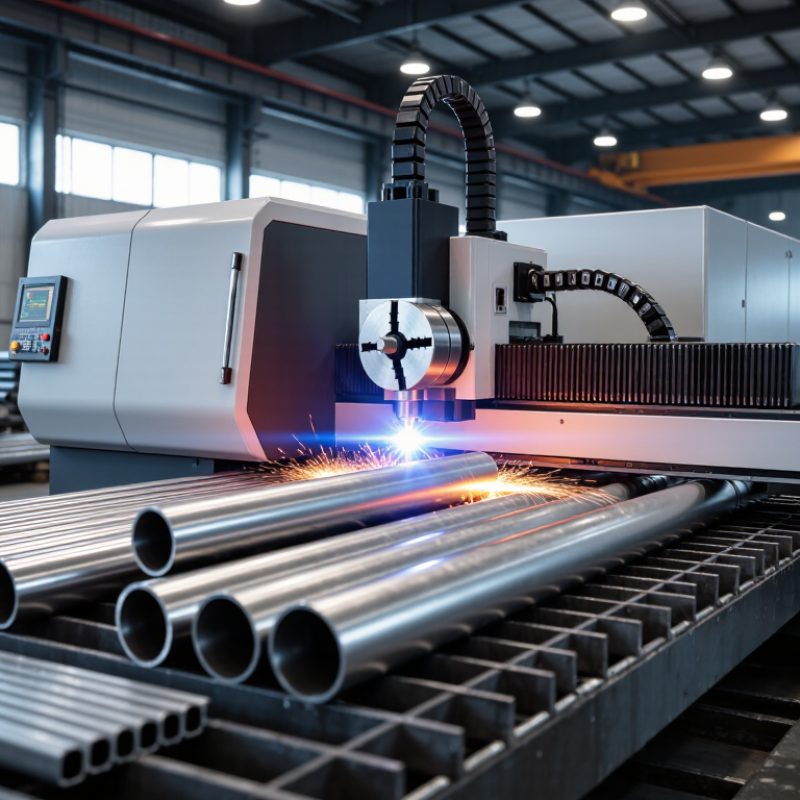
A fiber laser tube cutting machine uses a concentrated light beam to cut metal tubes and profiles. The beam comes from a fiber laser source and travels through an optical delivery system. A CNC controller moves the cutting head along programmed paths. A rotary chuck turns the tube during processing.

This setup can cut round, square, rectangular, and oval sections. It also creates holes, slots, miters, and complex joints without separate drilling. The process usually produces narrow kerfs and limited heat distortion. Fortune Business Insights valued the global fiber laser market at about USD 5.23 billion in 2023. Its 2024 report forecasts strong growth through 2032, supported by automotive, construction, and general fabrication demand. The number is useful, but market forecasts can shift quickly.

In daily production, accuracy depends on more than laser power. Tube straightness, chuck alignment, assist gas, and nesting quality all matter. A powerful machine can still make poor cuts. I have seen small setup errors leave rough edges around a 6-millimeter hole.

Tips: Check the material chart before cutting. Use a test piece first. Confirm wall thickness, tube rotation, and gas pressure. Ask suppliers for sample cuts, measured tolerances, maintenance records, and operator training details. Sensor calibration also deserves attention, although it is often overlooked.

Key Features of China’s Leading Tube Cutting Machine Suppliers

China’s leading tube cutting machine suppliers usually combine high-power fiber lasers with rigid steel frames. This structure reduces vibration during long production runs. Many machines cut round, square, rectangular, and elliptical profiles. Some models also process angled or open-section materials with suitable software. Check the real cutting range, not only the headline specification.

Automatic loading systems can reduce manual handling and improve workshop consistency. Servo-driven chucks hold tubes firmly without damaging thin walls. Advanced nesting software helps reduce material waste and shorten setup time. A practical supplier should provide cutting samples using your actual tube sizes and grades. Ask for measured tolerances.

Reliable suppliers also focus on operator safety and service access. Enclosed cutting areas, interlocks, extraction systems, and emergency controls support safer operation. Remote diagnostics can help engineers identify alarms before production stops. However, support quality varies between suppliers. Confirm response times, spare-parts availability, installation procedures, and training details in writing. A polished brochure is not enough.

Experienced buyers should inspect weld quality, cable routing, cooling stability, and software usability. These details often decide whether a machine performs well after several months. Energy consumption and maintenance costs deserve equal attention. Request references from factories with similar workloads. Even strong equipment may need adjustment for heat distortion, thin-wall tubes, or uneven material. That limitation should be discussed openly.

China Top Fiber Laser Tube Cutting Machine Suppliers: Key Feature Benchmarks

Typical technical ranges commonly available from Chinese tube cutting machine suppliers

The chart summarizes representative specifications frequently offered in China’s fiber laser tube cutting machine market. Typical systems support tube lengths of approximately 6,000 mm, round tube diameters up to around 220 mm, laser power from 1,000 to 6,000 W, positioning accuracy near 0.03 mm, and repeatability around 0.02 mm. Actual specifications vary according to machine configuration, material, and application requirements.

How to Evaluate Chinese Fiber Laser Tube Cutting Manufacturers

How to Evaluate Chinese Fiber Laser Tube Cutting Manufacturers

Evaluating Chinese fiber laser tube cutting manufacturers requires more than comparing online prices. Examine their engineering experience with round, square, rectangular, and irregular tubes. Ask how the machine handles thin stainless steel and thicker carbon steel. Request cutting samples using your actual tube sizes and drawings. Watch the process, not only the finished photographs. A stable machine should produce clean edges, consistent holes, and limited deformation.

Visit the factory or arrange a live video inspection. Check assembly areas, electrical cabinets, welding quality, and component traceability. Ask who designs the control system and rotary chuck. Confirm positioning accuracy, acceleration, cutting speed, and supported tube length. A supplier should provide measurable test results, not vague claims. Review safety certificates, installation procedures, operator training, and warranty terms. These details reveal professional discipline.

Service reliability deserves equal attention. Ask for response times, spare-part storage, remote diagnosis, and local technician coverage. Speak with several recent customers, preferably in industries similar to yours. A polished showroom can mislead. I once focused too heavily on cutting speed and overlooked loading efficiency. That mistake increased labor costs every day. Request a full production demonstration, including loading, clamping, piercing, cutting, and unloading. Leave room for doubt. Good manufacturers explain limitations instead of promising perfect results.

China Top Fiber Laser Tube Cutting Machine Suppliers - How to Evaluate Chinese Fiber Laser Tube Cutting Manufacturers

Evaluation Dimension What to Evaluate Practical Benchmark or Verifiable Data Recommended Verification Method Suggested Weight
Tube Cutting Capability Supported tube shapes, materials, dimensions, wall thicknesses, and maximum workpiece weight. Confirm compatibility with round, square, rectangular, oval, channel, and angle profiles where required. Record the supplier's stated diameter range and maximum tube length rather than relying on a general catalog description. Request a signed technical specification sheet and a cutting test using the buyer's actual tube profile and material. 15%
Laser Source and Power Matching Rated laser power, source efficiency, duty cycle, replacement terms, and suitability for the target material. Common industrial fiber-laser configurations include approximately 1–6 kW, but the correct power depends on material, thickness, speed, edge quality, and production volume. Higher power is not automatically better for every application. Compare cutting charts with measured samples, including material grade, thickness, gas pressure, nozzle size, and cutting speed. 12%
Accuracy and Repeatability Positioning accuracy, repeatability, chuck centering, tube deformation control, and cut-part consistency. The supplier should provide tolerance definitions based on a recognized machine-tool testing method. Accuracy claims are meaningful only when the test conditions, measuring equipment, tube size, and cutting length are disclosed. Ask for a factory acceptance test, dimensional inspection report, and repeated cutting of the same part at different positions along the tube. 12%
Automation and Material Handling Automatic loading, unloading, remnant handling, bundle loading, clamping, and collision protection. A production-oriented system should state loading method, maximum bundle weight, minimum remnant length, cycle sequence, and operator interventions. Automation should be assessed against the buyer's actual tube mix. Observe a complete loading-to-unloading cycle and record manual actions, cycle time, safety interlocks, and remnant recovery. 10%
Machine Structure and Motion System Bed construction, stress relief, guideways, rack-and-pinion system, servo motors, chuck design, and thermal stability. A credible manufacturer should identify the machine-bed treatment process, motion components, axis configuration, maintenance points, and allowable operating environment. Generic claims such as “heavy duty” should not be used as technical evidence. Review engineering drawings, component specifications, maintenance intervals, and machine serial-number records during a factory visit or remote inspection. 10%
Cutting Head and Process Control Autofocus function, height sensing, nozzle monitoring, protective window replacement, piercing control, and parameter management. The control system should support material-specific cutting parameters and provide alarms for common conditions such as loss of capacitance signal, overheating, or protective-window contamination. Request a live demonstration with mild steel, stainless steel, and aluminum samples where applicable. 9%
Software and File Compatibility CAD/CAM import, tube nesting, automatic feature recognition, post-processing, barcode or job management, and data backup. Verify compatibility with commonly used 2D and 3D file formats, nesting for tube profiles, lead-in and lead-out control, and editable process libraries. Confirm whether software updates and licenses are included. Provide representative customer drawings and test the complete workflow from file import to generated machine program. 8%
Quality Management and Compliance Documented quality system, traceability, electrical safety, guarding, emergency stops, and market-specific conformity documentation. ISO 9001 certification can indicate a documented quality-management system, but it does not by itself prove machine performance. For European sales, verify applicable CE documentation, risk assessment, declaration of conformity, and technical file availability. Check certificate validity with the issuing body and request the machine manual, electrical drawings, risk assessment, and conformity documents before shipment. 8%
Cutting Performance Evidence Actual throughput, edge quality, piercing time, gas consumption, burr level, and scrap rate. Performance data should specify material grade, thickness, tube dimensions, laser power, assist gas, gas pressure, nozzle, cutting speed, and part geometry. A single speed figure without test conditions is not comparable. Use a standard buyer-supplied test plan and compare measured results against the supplier's written quotation. 8%
After-Sales Service Installation, operator training, remote support, response time, spare-parts availability, and local service coverage. A clear service agreement should define installation scope, training hours, remote-response targets, escalation procedures, warranty exclusions, and recommended critical spares. Request service contact details, sample service reports, spare-parts lead times, and references from users with comparable machines. 5%
Warranty and Total Cost of Ownership Warranty duration, covered components, consumables, maintenance, energy, assist gas, software, and downtime exposure. Compare the total five-year operating cost rather than purchase price alone. Include protective windows, nozzles, lenses, filters, lubrication, electricity, assist gas, training, shipping, and expected downtime. Use a standardized total-cost worksheet and require separate pricing for consumables, spare parts, upgrades, and extended warranty coverage. 6%
Delivery and Project Execution Lead time, factory acceptance testing, packaging, installation readiness, site requirements, and commissioning schedule. The contract should identify agreed specifications, acceptance criteria, delivery milestones, packing requirements, utility requirements, and remedies for delayed delivery or failed acceptance testing. Use a milestone-based contract with pre-shipment inspection, documented acceptance tests, and photographs or video records of packing and loading. 5%
Recommended scoring approach: rate each dimension from 1 to 5, multiply by the suggested weight, and retain supporting documents for every score. Compare suppliers only when test conditions and specifications are equivalent. 100%

Main Applications and Materials for Tube Laser Cutting

Tube laser cutting serves industries that need clean joints, repeatable holes, and fast profile changes.

In China’s manufacturing sector, common applications include steel frames, handrails, fitness equipment, vehicle components, agricultural machines, and lighting structures. Square, rectangular, round, oval, and channel tubes can be processed with careful positioning.

Carbon steel is widely used for structural parts and machine bases. Stainless steel suits food equipment, medical fixtures, and decorative frames because it resists corrosion. Aluminum reduces weight in transport and architectural projects. Copper and brass require more controlled settings because they reflect laser energy and transfer heat quickly.

Wall thickness, tube diameter, surface condition, and required edge quality all affect cutting performance.

Operators often adjust power, speed, focus position, and assist gas pressure for each material. Nitrogen can help produce bright stainless-steel edges, while oxygen may increase cutting efficiency on carbon steel.

Small holes near a tube corner can deform if the setup is too aggressive. That detail is easy to miss. Not every supplier’s sample cut reflects daily production. Buyers should inspect trial parts, measure hole positions, and test long continuous runs.

In practice, software alignment errors and tube distortion still appear, especially with thin aluminum profiles. Careful calibration matters more than impressive specifications.

Purchasing, Customization, and After-Sales Service Considerations

China Top Fiber Laser Tube Cutting Machine Suppliers

Purchasing a fiber laser tube cutting machine requires more than comparing prices. A reliable supplier should explain laser power, chuck structure, cutting length, and material limits clearly. Ask for sample cuts using your actual tube profiles. Inspect round, square, rectangular, and irregular sections. The cut edge should remain clean, with limited dross and consistent hole positions. Request machine videos, test reports, installation details, and a written warranty. A polished demonstration is not enough.

Customization should match your production, not impress your visitors. Discuss automatic loading, nesting software, bevel cutting, dust extraction, and safety guarding. Confirm whether the control system supports your preferred file formats. Good suppliers provide drawings before production and confirm electrical requirements. Small mistakes matter. A poorly placed loading rack can slow operators every day. Purchasing teams should also check spare-part availability and technician response times. A low initial price may become expensive after repeated downtime.

Tips: Visit the supplier’s facility when possible. Speak with recent users, not only sales staff. Ask how failed components are diagnosed and replaced. Clarify remote support, on-site service fees, training hours, and response targets. Keep every promise in the contract. Also, leave room for review; real production may expose needs that were missed during planning.

Contact Us Today for a Free Quote

(800) 708-6036